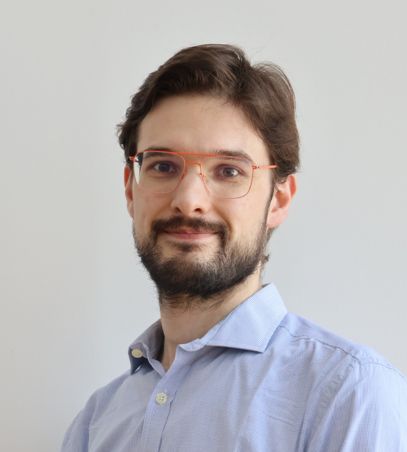
Eliott JACOPIN
招へい研究員
理化学研究所生命機能科学研究センター 特別研究員
- 関連ウェブサイト:
- ORCID



PRIMeの研究者
PRIMeでは、多様な分野、国籍、背景を持つ研究者がアンダーワンルーフで混ざり合い、学際的・統合的な研究ができる研究環境を醸成していきます。
Research Outline
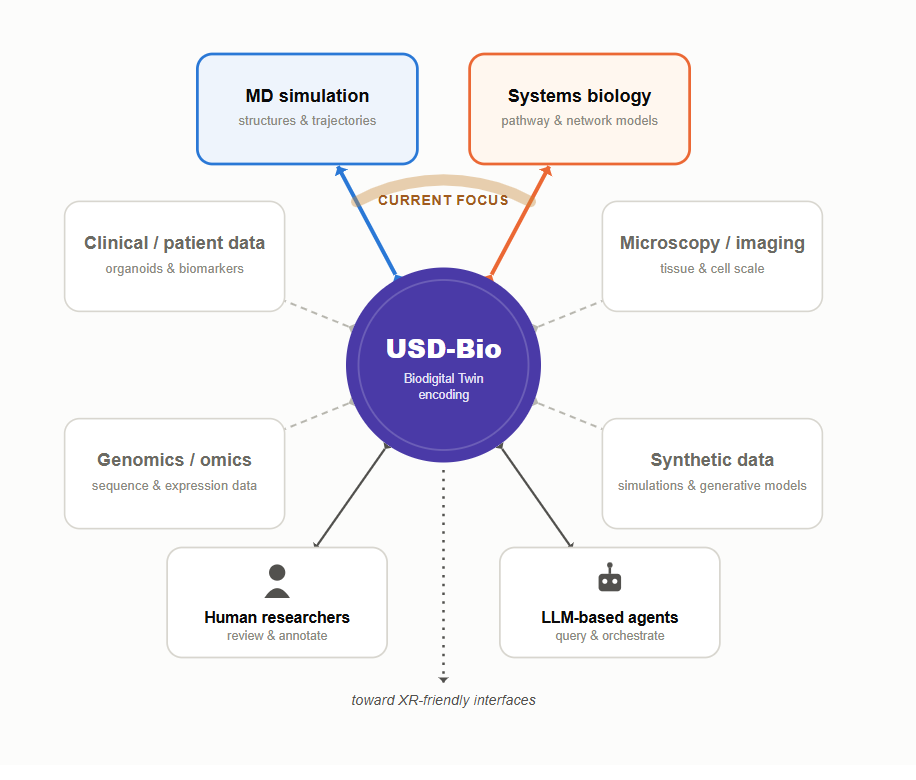
I develop shared computational representations that let molecular-scale data drive higher-level models of biological systems. My current project, usd-bio, uses OpenUSD, the composition-graph format used for large-scale collaborative 3D content, as the shared intermediate representation linking atomic structure, binding energetics, and pathway-level network models into one traceable biodigital twin. A molecular-dynamics pipeline is now coming online to complete the atomic-resolution layer of the twin. In parallel, I develop verifiable planning methods so that the LLM-based agents that increasingly query and orchestrate this representation do so reproducibly, rather than improvising a new sequence of actions on every run.2,3
WPI Project Plan
For PRIMe, this representation layer is designed to let organoid- and patient-derived data compose with molecular and pathway models inside a single, inspectable biodigital twin, and to support collaborative review of that twin in a shared virtual environment.
Background
At the University of Osaka, I built ECellEngine, a real-time simulation engine, and ECellDive, a virtual-reality client for collaborative modeling: an architecture for collaboration in systems biology “at the age of the Metaverse,” where every change to a model is recorded and attributable.1 That environment was built and tuned for human collaborators. The work described above hardens its techniques and technology so that the same Metaverse supports seamless collaboration between human and LLM-based agents in building, using, and updating biodigital twins.



大阪大学 ヒューマン・メタバース疾患研究拠点
〒565-0871 大阪府吹田市山田丘2-2
06-6210-8315
info@prime.osaka-u.ac.jp
© 2023 The University of Osaka, WPI Premium Research Institute for Human Metaverse Medicine (WPI-PRIMe)